monte-neo repair: repair defects without overfitting
Every other command says what is wrong. repair fixes it, and shows that the fix is not a new curve fit. It also says so
when there is nothing left to fix.
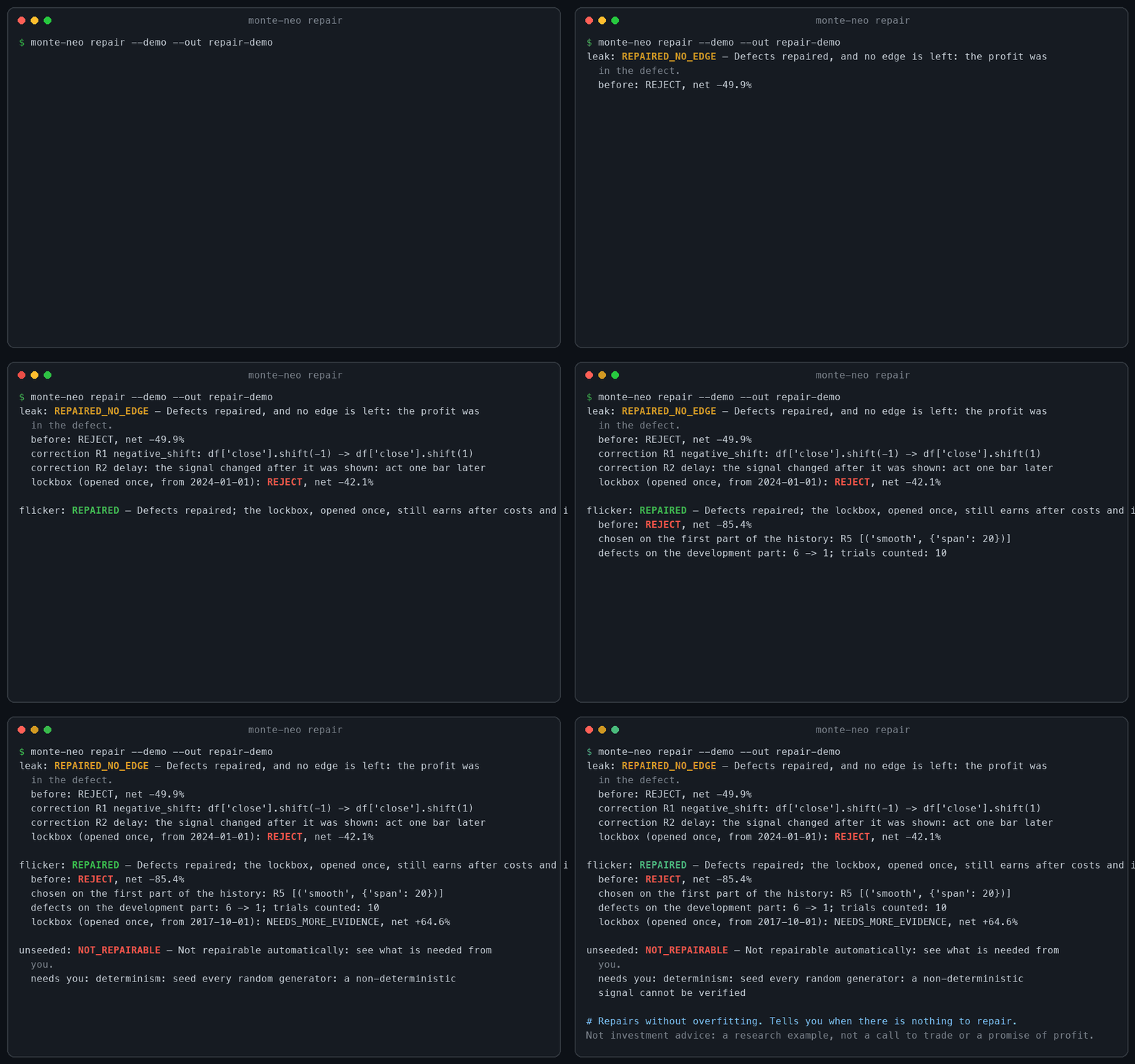
monte-neo repair --demo                                    # three strategies, three honest outcomes
monte-neo repair --ohlcv data.csv --strategy s.py --out repair/ [--commission-bps 10] [--rebalance-every 21]
Optimisers maximise the return, so they overfit. repair minimises defects, from a short list of declared repairs,
and lets a part of the history it has never seen decide.
The protocol
- Diagnose the original on all the data, as
verifydoes. - Stop on defects no transform can honestly repair: broken data, survivorship, files or network read by the
strategy, a non-deterministic signal, a model whose profit lives in fitting on the whole file, an edge that exists
only before a language model's training cutoff. The outcome is
NOT_REPAIRABLE, with what you need to do. - Correct look-ahead and repainting first. Look-ahead gets causal rewrites of the source (the same rules as
--suggest-fix); repainting gets a one-bar delay. These have no parameters, so there is nothing to choose. If the leak is still there afterwards, the outcome isNOT_REPAIRABLE. - Choose on the first 70 % of the history only, among a few declared repairs, by the number of defects left (a fail counts 3, a warning 1), never by return. Every candidate is added to the number of trials, so the Deflated Sharpe gets stricter with each one.
- Open the lockbox once: the chosen version on the last 30 %. The outcome is
REPAIREDonly when the whole-history certificate passes and the lockbox still earns after costs.
| Outcome | Exit code | Meaning |
|---|---|---|
REPAIRED |
0 | Defects removed; the lockbox (data the choice never saw) still earns after costs and is not rejected. It can still be NEEDS_MORE_EVIDENCE: read its failed checks |
REPAIRED_NO_EDGE |
1 | Defects removed, and no edge is left: the profit was in the defect |
NOT_REPAIRABLE |
2 | What blocks it and what you need to do |
NOTHING_TO_REPAIR |
4 | No defect the catalogue addresses; the strategy is not touched |
The catalogue
| Id | Defect | Repair (fixed values) |
|---|---|---|
| R1 | Look-ahead (shift(-1), centred windows, bfill, whole-series statistics) |
Causal rewrite of the source |
| R2 | Repainting | Act one bar later |
| R5 | Costs and turnover eat the profit; the edge lives in the next fill | Smoothing (span 5, 10, 20), a minimum holding period (5, 10, 20 bars), a no-trade band (0.25) |
| R7 | The result depends on the rebalance day (--rebalance-every) |
Four staggered tranches |
| R8 | The profit is market exposure | Cross-sectional neutralisation (universes) |
| R9 | Trades are large against the volume | Weight cap 0.1, no positions in the least liquid 20 % |
| R11 | Unstable risk, one period makes the profit, a policy breach | Volatility target 10 % a year, cap 0.5 |
Pairs of repairs from different families are tried too, up to --budget (24 by default).
What you get
--out holds:
strategy.repaired.py: the corrected original, renamed, the repair functions it uses, and a newsignal(df). It is self-contained and runs without Monte-Neo.strategy.corrected.py: the original after the look-ahead rewrite, before any economic repair (the repair loads it the wayverifyloads a strategy file).repair.diff,certificate.json(the repaired strategy on all the data, with the trials counted).repair-report.jsonandrepair-report.html: before and after, the lockbox, every candidate and its defect count.
The original file is never changed. Recheck the certificate with
monte-neo verify --recheck repair/certificate.json --ohlcv data.csv --strategy repair/strategy.repaired.py.
What the demo shows
- leak: reads tomorrow's close. R1 rewrites it and R2 delays it.
REPAIRED_NO_EDGE: on a random walk, the profit was the leak. - flicker: a real 40-day trend signal that flips almost daily, with 10 bps costs. It loses 85 % before the repair.
Smoothing (span 20) is chosen on the first 70 %, and the lockbox earns after costs:
REPAIRED. - unseeded: random positions without a seed.
NOT_REPAIRABLE: seed every random generator.
How it is tested
Zoo A16 runs repair on every leaking strategy of the Trap Suite on a random walk. A REPAIRED there would mean the
repair invented an edge. In the full run, 68 leaking strategies were repaired with no REPAIRED outcome, and 9 were
skipped because they need other data columns. The original files are checked to be unchanged.
Do not run repair again and again on the same data to look for a better outcome. That is the search the protocol
exists to prevent.
Not investment advice: a research example, not a call to trade or a promise of profit. Simulated results do not predict future returns.