Latency audit: look-ahead that hides in milliseconds
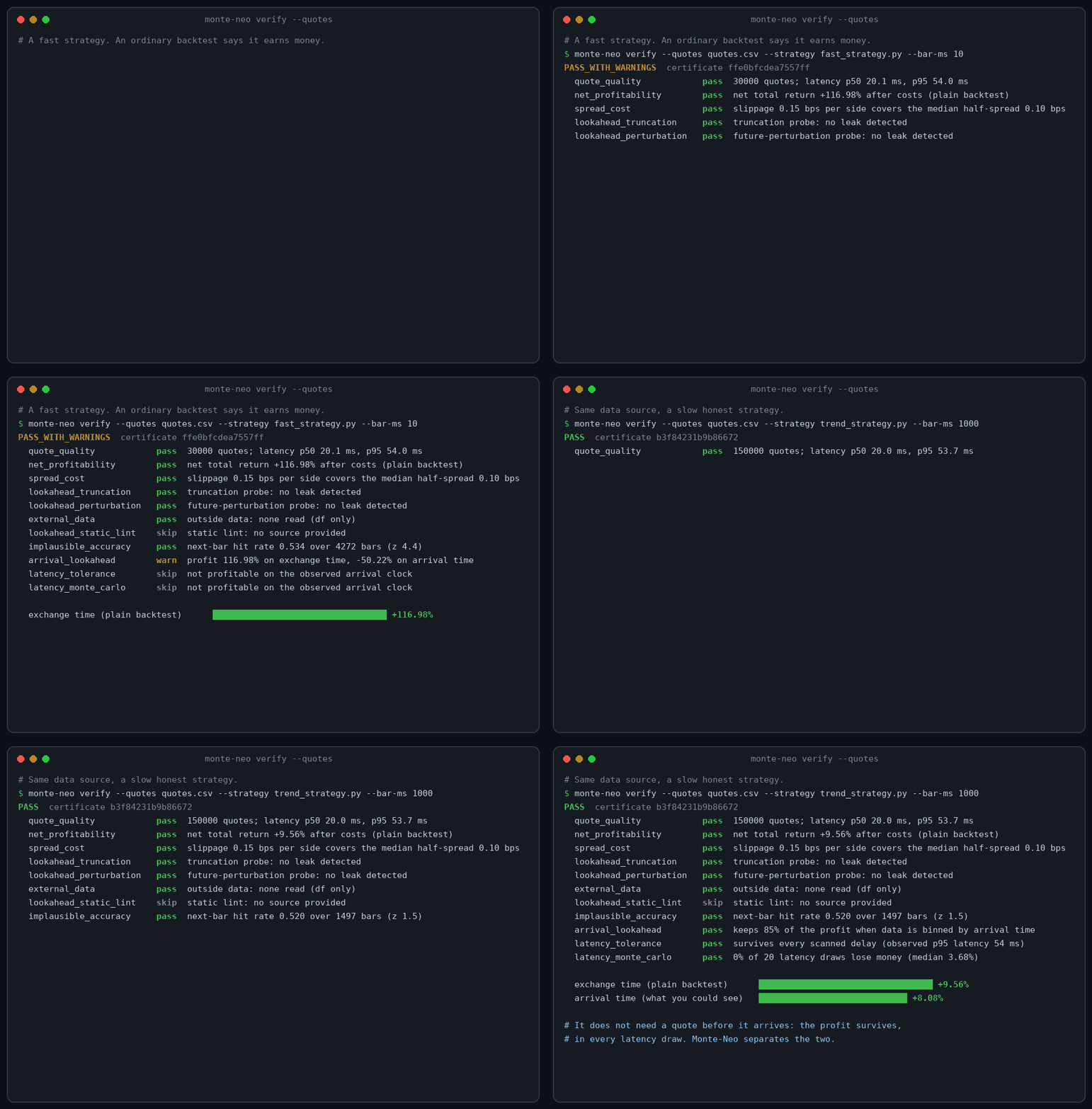
A strategy built on intraday bid/ask quotes can look profitable only because the backtest let it act on prices it could not
have known yet. monte-neo verify --quotes finds that, tells you at which delay the profit disappears, and puts the answer
in a certificate you can reproduce.
Status: experimental
The latency checks are context: they warn, they do not fail the verdict (the only fail is a strategy that loses money
after costs even on the plain backtest). They were calibrated on synthetic data. Record real latency on the machine that
will trade before you trust a number. See Limits.
The problem
A quote has two times: the moment the exchange stamped it and the moment it reached your machine (stamp + latency).
exchange stamp     |-----|-----|-----|-----|-----|
arrival            .  |-----|-----|-----|-----|-----|      (20 ms late, median)
A backtest that cuts bars by the stamp gives the strategy a bar that closed 10 ms ago, while on a real machine that bar's quotes are still on their way. A fast strategy then trades on the future of its own information. This is look-ahead, but no static lint and no truncation probe can see it: the leak is in the clock, not in the code.
What it catches
| Failure | How it shows up |
|---|---|
| The strategy reacts to a bar before its quotes arrived | arrival_lookahead warns: profit on exchange time, a loss on arrival time |
| The edge is thinner than the data delay | latency_tolerance warns and names the extra delay in ms where the profit vanishes |
| The profit was lucky latency | latency_monte_carlo warns: most redraws of the latency lose money while the observed sample earned |
| The edge lives in instant execution | With --order-latency-ms the plain backtest turns into a loss and the verdict is REJECT |
| A leader feed arrives after the follower moved (latency arbitrage) | arrival_lookahead warns when a strategy that trades one instrument on the move of another earns only on exchange time |
The strategy reads the future of its own bars (shift(-1)) |
The look-ahead probes of verify_strategy run on the arrival bars and REJECT it: this leak exists on every clock |
| Costs ignore the spread | spread_cost warns when the modeled slippage is below the half-spread a taker pays |
| The recording itself is unreliable | quote_quality warns about crossed quotes, negative latency, rows that did not parse and bursty latency |
The last row matters. A congested path (VPN, Wi-Fi, an overloaded router) holds messages back and releases them in bursts. On a real two-minute recording the latency climbed from 0.5 s to 12 s and then drained in one burst. The check reports that, instead of letting your network pass as a property of the strategy.
What it gives you
- A number you can act on: "the profit vanishes at 38 ms of extra delay (observed p95 latency 54 ms)".
- A distribution, not a single run: 200 seeded redraws of the observed latency, with p5, median, p95 and the probability of a loss.
- A verdict in the same
strategy-verdict/1format as every other certificate, which can be signed and checked with--recheck. - An HTML report with a "Time and latency" section and a chart of the return against the extra delay.
- The same result through the CLI, the Python API and the MCP tool
verify_quotes, so an agent can audit its own intraday strategy.
Try it
monte-neo verify --demo-quotes # no files: a fast strategy and an honest one, on synthetic quotes
With your own files (signal(df) gets bars of open, high, low, close, volume built from the mid price):
monte-neo verify --quotes quotes.csv --strategy my_strategy.py --bar-ms 1000 \
    --commission-bps 0.5 --slippage-bps 0 --order-latency-ms 20 --html report.html --out cert.json
monte-neo verify --recheck cert.json --quotes quotes.csv --strategy my_strategy.py     # reproduce it
The quotes table needs timestamp, bid, ask and the latency as latency_ms (or an arrival timestamp). The column names
bid_price, ask_price, latency and ticker are accepted too. A table of several symbols needs --symbol.
from monte_neo.verify import verify_quotes

report = verify_quotes("quotes.csv", strategy="my_strategy.py", bar_ms=1000, symbol="BTCUSDT@BINANCE-FUTURES")
No server near the exchange? Assume the latency
Measuring latency needs a machine near the exchange. Without one you can still ask the question that matters: how much latency can this strategy take? Give the latency yourself (a ping to the server you will rent, a provider's figure), and the table does not even need a latency column:
monte-neo verify --quotes quotes.csv --strategy my_strategy.py --bar-ms 100 --latency-model lognormal:8,25   # median 8 ms, p95 25 ms
monte-neo verify --quotes quotes.csv --strategy my_strategy.py --bar-ms 100 --latency-model constant:5
The certificate records latency_model and says in plain words that the latency is assumed, not measured, so the verdict
holds only if the real latency is not worse. The prices stay real: the exchange's own timestamps are exact on any network, only
your receive time is not. Use latency_scan (the table of returns against extra delay) to see the whole curve instead of one point.
Several feeds in one strategy
A strategy may trade one instrument on the prices of another (lead-lag, cross-venue, futures against spot). Select the traded
symbol and the feeds it reads; each feed has its own latency, and its columns are prefixed with the symbol, non-word
characters replaced by _:
monte-neo verify --quotes both.csv --strategy lead_lag.py --symbol LAG@SIM --feeds LEAD@SIM --bar-ms 10
def signal(df):                                   # df.close is LAG@SIM, df.LEAD_SIM_close is LEAD@SIM
    return np.sign(df["LEAD_SIM_close"].diff(3).fillna(0.0).to_numpy())
On the synthetic pair the follower repeats the leader 30 ms later. With a leader that reaches the machine in 1 to 5 ms the edge
survives; with a leader 30 ms late or more the exchange-time profit turns into a loss on arrival time and arrival_lookahead warns.
Record your own latency
Latency is a property of your machine and your network, so measure it where the strategy will run:
pip install "monte-neo[data]"
python -m monte_neo.data.quote_recorder --symbol BTCUSDT --seconds 600 --out quotes.csv
The recorder takes Binance USD-M futures bookTicker quotes and writes the receive time corrected by the clock offset to
the exchange, minus the exchange's event time. The summary says how well the offset is known; when it is only known to
within about 10 ms or worse, the latencies are not trustworthy at that scale and the recorder says so. Run it on a server in
the exchange's region (for Binance futures, AWS Tokyo), not behind a VPN. E has millisecond resolution, so latencies are
quantized to 1 ms.
How to read the output
| Check | Status | Meaning |
|---|---|---|
quote_quality |
warn |
The quotes are not clean: read the summary |
net_profitability |
fail |
The plain backtest loses money after costs: REJECT, as in verify_strategy |
arrival_lookahead |
warn |
The profit does not survive binning by arrival time |
latency_tolerance |
warn |
One more observed p95 of delay erases the profit |
latency_monte_carlo |
warn |
More than half of the latency redraws lose money |
| any of the three | skip |
There is no profit to lose: the strategy does not earn on the plain backtest |
| any of the three | pass |
The profit did not turn negative; retained in the details says how much is left (a 15% retained still passes: read it) |
What sets it apart
| A latency model inside a backtest | Monte-Neo --quotes |
|
|---|---|---|
| Role | Part of the environment the strategy is built and run in | An independent audit of a finished strategy |
| Strategy | Written for that environment | Any signal(df) function, from any framework or an agent |
| Latency source | A model you configure | The latency you recorded (redrawn per venue), or one you state (--latency-model) |
| Output | Backtest results | A verdict, the ms where the profit vanishes, a certificate others can reproduce |
To our knowledge, no other independent verifier checks arrival-time look-ahead.
Limits
- Experimental. The checks warn and do not fail the verdict; the honest-strategy controls (several seeds, three latency levels and an order delay) ran on synthetic data.
- One traded instrument per run. Pick it with
--symbol; other feeds are read through--feeds. A strategy that trades several instruments at once is not supported. - Information latency plus a fixed order delay.
--order-latency-msdelays every fill by a constant. Queue position and partial fills are not modelled, on purpose: they need the order book and the trade prints and a passive-order model, and a rough formula would give false precision. Fills are taker orders at the mid, so market-making (passive-order) strategies are out of scope. Every certificate lists these assumptions inassumptions. - Bars from the mid price. The strategy sees
open, high, low, closeof the mid andvolume, the count of quotes. - The strategy file runs with your permissions, as with
verify_strategy; the--isolatesandbox does not apply to--quotesyet. - The look-ahead probes run on the arrival bars (
--no-probesskips them), so a strategy that reads the future of its bars is caught; the statistical checks ofverify_strategy(Deflated Sharpe, timing test) do not run.
Checked on real quotes
scripts/validate_on_real_quotes.py runs the checks on real recordings. The run behind these numbers used 15 minutes each of
Binance USD-M futures BTCUSDT, ETHUSDT and SOLUSDT (1.18 million real quotes, 1 October 2026), recorded on the author's own
network. The prices and exchange timestamps are real; that network is too congested to trust its latency, so every run
assumed a latency (lognormal:5,15, lognormal:20,60, constant:50) with costs of 0.2 bps commission + 0.3 bps slippage.
| What ran | Result |
|---|---|
| 36 honest strategies (3-bar trend, mean reversion, breakout, fast momentum; 3 recordings; 3 latency scenarios) | 0 rejected for any reason other than losing money; 33 rejected because they lose money after costs, 3 passed (BTC breakout, +0.01%) with no latency warning |
Foresight control (shift(-1)) on each recording |
3 of 3 rejected by lookahead_truncation |
| A real pair, ETH traded on the move of BTC (100 ms bars) | Loses money after costs: nothing to audit |
| An edge planted on the real SOL price path: a follower that repeats it 2 s later | Passes at 20 to 500 ms of latency, latency_tolerance warns at 1.5 s, arrival_lookahead warns at 2.5 s (+2.08% on exchange time, -1.64% on arrival time) |
How to read it, honestly: on real prices there was almost no honest edge to audit, which is what an independent verifier should report. The latency checks fired only where the ground truth was planted (the 2 s lag), and at the delay that matches it. What this does not show: how often the warnings accuse an honest strategy that really earns, because only three honest runs earned anything. Fifteen minutes of one day is a smoke test, not a study. Run the script on your own recordings.
Speed
Measured on an Apple M1 Pro with synthetic quotes and a three-bar trend rule: 1 million quotes load in 0.6 s and quote_quality
takes 0.06 s; the whole verify_quotes takes 1.3 s with 20 latency draws on 1 s bars, 7 s with 200 draws on 100 ms bars
(100 000 bars) and 11 s on 20 ms bars (500 000 bars). The cost is the strategy's own signal(df), run once per draw.
Further reading
- API reference
- Trap Suite: the arrival traps and honest controls live in
tests/traps/test_quote_traps.py - Use from agents: the MCP tool
verify_quotes