Alpha validation: does a ranking signal predict returns, and can it be traded?
monte-neo alpha (MCP tool validate_alpha) checks a cross-sectional score: a number per symbol and date that
should rank the returns that follow. It answers two questions a fund's research committee asks before a signal gets
capital:
- Does the score predict anything? (family A, signal power)
- Can its portfolio be traded at the size you plan? (family D, implementability)
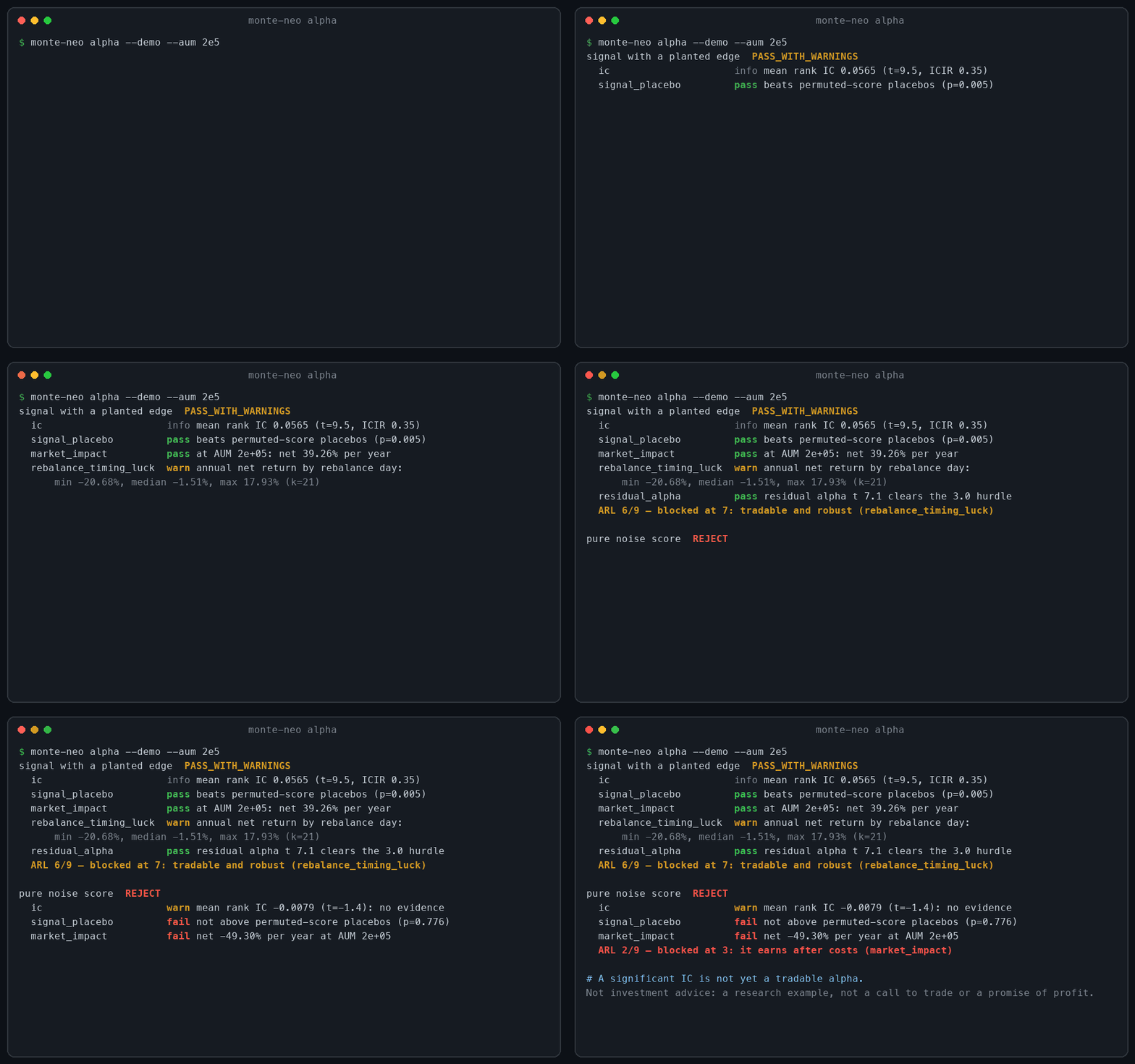
monte-neo alpha --demo                                              # no files: a weak real edge and a noise score
monte-neo alpha --ohlcv universe.csv --scores scores.csv --aum 5e7  # your data and the capital you plan to run
Inputs:
--ohlcv: one long table for the universe withtimestamp,symbol,closeand, for family D,volume.--scores:timestamp(ordate),symbol,score. The score at t ranks the returns after t. Scores are never filled forward, and a score dated after the last price is an error.
The output is an alpha-report/1 report with a verdict, the checks, metrics and next actions.
Family A: signal power
| Check | What it measures | Status |
|---|---|---|
ic |
Mean rank (Spearman) IC per date against the next return, ICIR and a Newey-West t-statistic | info when the mean IC is positive and t ≥ 2, else warn |
ic_decay |
IC at horizons 1 to 20 bars, the best horizon and the half-life | info |
quantile_monotonicity |
Do returns rise from the worst to the best quantile, or does all the profit sit in one tail? | pass or warn |
long_short_legs |
Share of the spread earned by the short leg | warn above 70 % |
breadth_consistency |
A claimed IR (--claim-ir) against IC × √breadth |
warn above twice the implied IR |
signal_placebo |
200 scores permuted among symbols within each date: does the real score beat them? | fail when p > 0.10 |
selection_vs_timing |
Is the spread stock selection, or a fixed tilt that survives shuffled dates? | info |
Family D: implementability
The portfolio is long the top quantile and short the bottom one, with equal weights.
| Check | What it measures | Status |
|---|---|---|
market_impact |
Square-root impact at --aum (trailing 20-bar volatility and dollar volume, no look-ahead) |
fail when the net return is ≤ 0, warn when impact eats more than half the gross |
participation_limit |
Your trades as a share of each bar's volume at --aum |
warn when the 95th percentile is above 5 %, fail above 20 % |
capacity_curve |
Net Sharpe from 100 thousand to 10 billion: where it halves and where it reaches zero | info |
short_feasibility |
Short exposure in the least liquid names, and borrow (300 bps a year unless stated) against the short leg's profit | warn |
turnover_vs_decay |
Holding period against the IC half-life | info |
rebalance_timing_luck |
The same portfolio rebalanced every 21 bars on each of the 21 possible days | warn when the spread of results exceeds the median |
Without --aum, market impact and participation are skipped and the report says why.
Families B, C, E, F, G and I: on the score's long-short portfolio
These families judge the returns of the same top-minus-bottom portfolio, before costs: they ask whether the signal is real. Costs and size are family D's job.
| Family | Checks | Needs |
|---|---|---|
| B, attribution | factor_exposure, residual_alpha (is it alpha after market, size, momentum, reversal and low-volatility factors? t ≥ 3 passes), factor_spanning, hidden_short_volatility (steady gains and rare crashes), market_timing_beta, crowding, known_anomaly_match |
factors are built from your universe; --factors file.csv uses yours |
| C, value to your book | book_correlation (also in the book's worst bars), marginal_sharpe (the book's Sharpe gain, with a bootstrap interval), residual_vs_book, drawdown_overlap; signal_orthogonality (partial IC after the signals you already run) |
--book book.csv (date + one column per strategy), --existing-scores scores.csv; skipped without them |
| F, all the attempts | hlz_hurdle (t ≥ 3), min_backtest_length, drawdown_plausibility, haircut_sharpe |
--n-trials |
| I, risk | neutrality, concentration, leverage_gross_net, historical_stress_replay (named crises found in your dates), tail_risk |
— |
| E, robustness | universe_subsampling (70 % subsets, top-5 share), group_split (--groups), start_date_sensitivity, cpcv_paths, synthetic_market_null (bootstrapped markets without the score's link), noise_injection, data_source_replication (API: a second price source), bar_construction | — |
| G, data and process | universe_lookahead (--membership; without it, a warning when the universe looks like today's members), classification_lookahead, cross_market_close_alignment (--exchanges), post_discovery_decay (--discovery-date), research_hygiene | optional files |
--signal-only runs families A and D only. Every report ends with an
Alpha Readiness Level, for example
ARL 6/9 — blocked at 7: tradable and robust (rebalance_timing_luck).
Reading the demo
The demo's real score has a rank IC of about 0.05 with t ≈ 9 and beats the placebos. It still gets REJECT
with --aum 5e7, because daily rebalancing of illiquid names at that size costs more than the edge. The noise score
fails the placebo test. That is the point of the command: a significant IC is not yet a tradable alpha.
Honest scope
- Self-built factors are proxies: size is ranked by traded value, and there is no value factor without fundamentals.
Pass
--factorswith academic or vendor factors for a stricter attribution. - Impact uses the square-root model with a coefficient of 1: a model, not a measurement.
- The score is taken as given. To check the code that makes it for look-ahead, verify that code with
monte-neo verify.
Not investment advice: a research example, not a call to trade or a promise of profit. Simulated results do not predict future returns.